
Growing up inside the internet: an interview with Hurricane
I speak with the sonic architect behind DL91 and the man at the helm of a new wave in Indian Hip-Hop
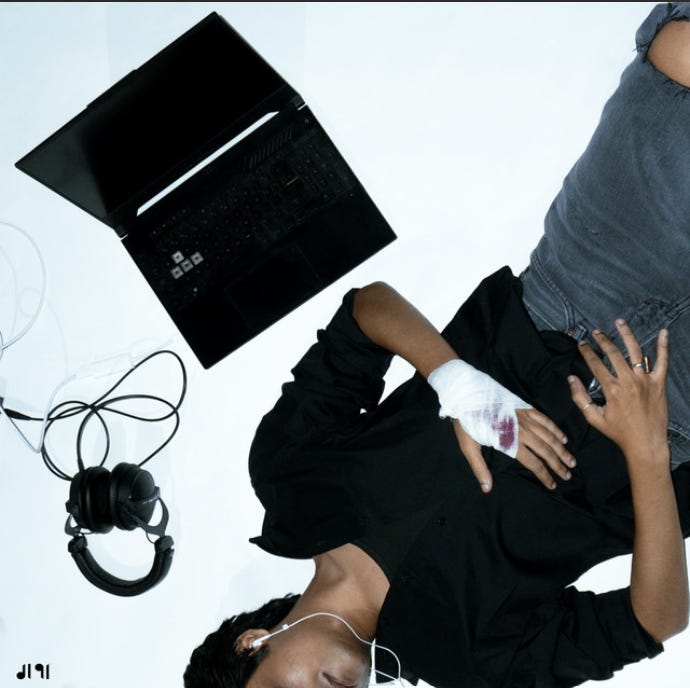
Hurricane is a digital being— a collection of well-travelled bits bound together by the roots and influences of Boudhayan Kundu (BK). Hurricane emerged from the remains of a Type 1a digital Supernova that occurred many years ago on the internet when a remote untouched corner collapsed into its core and produced a neon blue stream of bytes that struck the capital city. I catch up with Hurricane over the old internet, where I often broadcast my writing to escape the Machine1 and fight the (Social Engineering Against Rebels) SEAR program. Over rickety BSNL copper cables, our discussion traverses his experiences travelling the digital galaxy, his musical influences, seminal work with DL91, and his philosophy toward creation. All of this leads us to his debut album GORE!, an album that attempts to make sense of growing up inside the internet.
The interview has been edited for length and clarity.
tejas: I wanna start with Limerence, your debut EP and entry into the scene.
HURRICANE: that was the first time I put out any music.
tejas: nice, so, straight up, was Bachte De a Bengali song?
HURRICANE: (chuckles) yeah, it is.
tejas: Crazy! that’s probably the first time I’ve heard Bengali rage rap.
HURRICANE: yeah, I used to make tracks in Bengali when I first started, so some of my initial releases are in Bengali.
tejas: Before Limerence, which is your first EP as Hurricane, were you dropping music under another name?
HURRICANE: no, my musical output has always been as Hurricane. I have never had another monicker.
tejas: What influenced your sound when you started out? I hear a lot of Trap production on Limerence.
HURRICANE: I think the one person that has really influenced me was Kanye. Around that time, I was actually listening to a lot of alt rap like JPEGMAFIA. Of course, I was also listening to mainstream Trap artists like Carti and Uzi, but yeah, my biggest influence around then was Kanye.
tejas: in 808s and heartbreak, we see Kanye use his voice as an instrument. This started a new wave of production in hip-hop. Your vocals in the DHH scene are very distinct and characteristic to you. Does this influence come from there?
HURRICANE: I would say that my influence comes from Yeezus. Yeezus is the sound I sort of grew up playing and listening to with my friends and cousins. The Life of Pablo (TLOP) too. That entire 2016 era of music is embedded in me. Specifically, SoundCloud era with artists like Trippie Redd has embedded itself in my work and that kind of reflects in the music I was trying to make.
I was listening to a lot of Brockhampton when I was making Limerence. The idea to pitch up my vocals comes from Kevin Abstract’s delivery. If you listen to Dont Cry, you can see a lot of <Kevin Abstract> influence. I was also listening to a lot of bedroom pop, like Clairo, girl in red, and a bit of indie rock too. This reflects in the EP and my delivery.
tejas: at what stage did you decide that you wanted to make music?
HURRICANE: it was definitely when I was listening to Kanye. He was the first artist that I saw produce, write, and compose his own songs. He was my clicking point.
tejas: and when did BK become Hurricane?
HURRICANE: I think 2018, when I was 19 years old. That was when I first opened FL. It took me a couple years to figure the software out(chuckles), but yeah, that’s when I started.
tejas: Kanye and his Yeezus era being your entry point is so interesting to me. The newer generation of artists grew up on, and are trying to emulate, 808s and Heartbreak and the emo-trap it influenced. Of course there is Graduation too, but that was before our time.
HURRICANE: yeah, I actually listened to Graduation much later. Same for 808s. Yeezus and TLOP were my main influences.
tejas: I can see that influence in all the music you make, specifically in the distortion that you incorporate in your sound.
HURRICANE: Yeah, I usually source my sound from different parts of the internet. I was listening to Slauson Malone’s album A Quiet Farwell a lot back when I started out, and his way of making music stuck with me.
tejas: damn, Slauson Malone is a deep, deep cut. That’s crazy.
HURRICANE: I started making beats while sampling because I didn’t know how to play any instruments initially. If you see his<Slauson Malone> music, it’s very jazz-esque and almost a sound collage. So yeah, that sort of style stuck with me. JPEGMAFIA as well.
tejas: yeah, JPEG tracks are like collages too. They start at a specific point, and the track just keeps building.
HURRICANE: especially his second album—all my heroes are cornballs.
tejas: Sorry, but I want to go back to Slauson Malone for a second. How did you come across his work? I heard a track of his pop up in my autoplay and it was unlike anything I had ever heard. It’s based on this book he wrote, right? And each track is like pages of the book?
HURRICANE: Yeah, and the beginning is the end, and the end is the beginning. It loops back so essentially the album restarts. I came across his album through Fantano(laughs). I watch a lot of Fantano.
tejas: Nice. You’re tapped in to the American underground scene then.
HURRICANE: I would say I’m tapped in to YouTube (chuckles). I pay attention to all corners of the internet.
tejas: Interesting. So maybe we’ll explore that a little later with GORE! because I feel like that’s very much a product of the internet. But before that, I want to talk about the Rick Owens quote you mentioned in your TED talk
since entering the scene in 2022, you’ve relentlessly put out music. At what stage of this entire process would you say you’re in right now?
HURRICANE: I would like to think I have not found my sound yet. I hope I turn into something entirely different in the future. Your sound is an emergent property. What I strongly believe is that some things you can only experience when you’re inside of it. A lot of my decisions come in very mundane aspects of just working and not having an end goal to this. That’s how I’ve been working throughout my artistic journey so far. That being said, I do want to kind of move away from this approach going forward. I don’t want to be locked in to just one method of creation. The Rick Owens quote resonates with me because he also just says that don’t just do sketches. Stitch the whole thing. It comes down to the essence of music creation. You need to understand the whole process. But going forward, I also want to start being more intentional with my craft. I don’t want this to be the only philosophy I abide to.
tejas: the way I see it, you establish a routine of creation and then you become more intentional.
HURRICANE: yeah, once your craft is established, then you can show restraint. Minimalism is only Minimalist if you have things to take out.
tejas: Expanding on this a little bit more. This philosophy is you as a solo artist. When you collaborate with someone, what is the thought process like?
HURRICANE: trust the other person’s vision. Everyone I’ve worked with, I’m a fan. They trust me with the sonics, I trust them with the vocals. All artistic decisions are made based on trust. You can’t put another person in your box.
tejas: and after y’all reach a place of trust, how does it go from there? Do you just spitball ideas?
HURRICANE: oh, then it becomes very simple. If I were to use DL 91 as an example, I create sonics and once it clicks with the artist, they drop their vocals on it. Very simple.
tejas: I guess this sort of ties back to the Rick Owens quote from earlier then, right? You keep creating output and something clicks?
HURRICANE: Yeah, there needs to be a clicking point.
tejas: Walk me through your journey entering, and signing, DL91.
HURRICANE: bhai, it was just discord. (chuckles) everything in my journey so far has been through the internet. But yeah, I used to make beats on discord with Teck and Raghav. Calm was friends with Teck and he showed him the stuff we were working on and Calm then approached me. I got signed right after I graduated college and then moved to Delhi.
tejas: What was making music in college like? Having to be a college student by day, producer by night. Did you perform in college?
HURRICANE: (laughs) they never let me. My music was too niche for them. My college was in Ranchi, Jharkhand and it was an engineering college. I studied math. So overall, not the right crowd for my music. But yeah, I was on discord throughout and actually, Limerence is a product of that work throughout college.
tejas: did you have a group of people who fucked with a similar sound?
HURRICANE: well, there were a couple friends who I used to send music to regularly because we had similar tastes. My other friends and hostel-mates knew that something was up but couldn’t quite piece it together. There was no community as such, though.
tejas: What was that like, this feeling of having to maintain an alter ego to interact with your environment? Was there some dissonance between your music-making identity and the way you engaged with your surroundings?
HURRICANE: of course! There was definitely some disparity. But also, I never really thought too much about it. I just wanted to make things. I was always creating when I was free. I wanted to make this shit work. Before Limerence, there was another album I was working on, but I scrapped it because it didn’t scratch that itch. I stripped it down to the 4 best tracks and just released it.
tejas: so you were kinda just going with the flow. And through it all, you just never stopped.
HURRICANE: yeah, pretty much. I woke up every morning, opened FL, and just made shit. I used to carry all my equipment in this briefcase and so all my friends used to look at me like what’s bro up to? Those were fun times, man. I miss them sometimes.
tejas: The college experience in a sense is a journey toward finding your identity. We get this direction we orient towards. Did you find a direction you wanted to go with this artist stuff? Did that vision present itself to you in college?
HURRICANE: it was always in the background, hovering over everything I did. It was one thing I wanted to do; one among many what ifs. But I did find my identity in the sense that I knew how I wanted to sound, but that too is ever-changing. I keep finding that feeling from time to time, but college was where I felt this feeling for the first time.
tejas: what if you weren’t a musician?
HURRICANE:(laughs) corporate job, what else. On that data analyst type shit.
tejas: Let’s talk about DL91 FM. This was a big project for the label, seeing that it was newly formed. There is a clear distinction between the Seedhe Maut sound before and after this album, so it is also a milestone in their career. A big architect of the sound was you behind the boards. We spoke about how y’all made the tracks. But how did the vision to make such an electronics-influenced album come about?
HURRICANE: During Limerence, I was listening to a lot of jazz and experimental stuff. During DL91, I was listening to a lot of electronic music. Shout to Calm, Encore, and the whole DL91 gang— they trusted me entirely with the sound. The project is not mainstream DHH-coded so there was no basis for it. I never had any pre-defined notion as to what the sound needed to be— it was pure feeling. I just asked them what they were feeling at the start of every session and we went from there. So, the electronic elements emerged from my listening habits, and the tracks itself emerge from emotions in the studio.
tejas: How were the sessions? I think Encore even references how late into the night y’all were recording music in some of the tracks.
HURRICANE: bhai it was relentless. We were continuously recording. For example, PANCAKE, the first song that came out, was the third song of the session that day. We made dil se, then another track, and finally pancake. And it was like 8am by the time we were done with the tracks.
tejas: What was the creative energy like?
HURRICANE: very high. Constantly moving forward and finding clicking points. It is made to sound like a radio station, right? The idea was that you would hear something new in each track, as if you’re turning to a station.
tejas: did you feel any difference while working with a more established act like Seedhe Maut vs relative newcomers like the 71 gang?
HURRICANE: I think in general by the time work for DL91 had begun, my workflow had entirely shifted. I wasn’t making beats like I used to. I transitioned from making beats with the intent to sell them to crafting songs with a structure in mind with a live feedback loop. My earlier tracks were made to have ear candy—I was working on textures, now, I work on structure. I think of how a track can evolve and morph into something different. I focus on the entire idea as a whole, not just the high points.
tejas: do you think about track length while constructing a song?
HURRICANE: when I make my own stuff I don’t think about track length at all. As a producer, I consider it. But it’s more about how much time I need to get an idea across. It’s also down to the feedback from the collaborators.
tejas: Subsequent albums since DL91 by the label have at least some of the elements present from the album. Are you still bumping house, jerk, and electronic sounds?
HURRICANE: yeah, these genres are still in rotation, but I’ve also begun listening to a lot of mk.gee, Magdalena Bay, and Drain Gang off late. Alex G as well.
tejas: A lot of the projects you just listed is all in some sense a product of the internet. Either their music stems from sounds off the internet, or they are niche underground pulls that reached the Indian listener via the internet
HURRICANE: (chuckles) yeah, that’s my fate. Everything I consume and interact with is through the internet.
tejas: So then, in some way, Hurricane is a product/offshoot of the internet.
HURRICANE: oh definitely, I come from this remote ass city in West Bengal— Asansol. It has no scene whatsoever. The only interfacing I did with the culture, at least what I liked of it, was through the internet.
tejas: When did you first get access to the internet?
HURRICANE: too early(chuckles) around 2007, I think.
tejas: let’s talk about GORE! You’re now in the capital city, making music. You entered the internet in 2007 and it’s now 2026. How many years was the project in the making?
HURRICANE: probably like 2 years. The oldest song on there is from 2023, when I was still in college. I made make shift then.
tejas: Listening to the project, it pushes you into your world from minute one. There is no easing in, it just,,,starts and now you’re in this glitchy, internet collage atmosphere. What were the ideas you were working toward on GORE! How did the concept come about?
HURRICANE: it’s pretty funny actually. Imagine this is 2010, you’re accessing the internet for the first time. You end up on a seedy website and click on a random ad, and now you’re in a gore or porn website. You’re single-digit-age old. This will fuck you up completely (laughs). So that first break of innocence, that point of contention, that is what the album is about. I didn’t sign up for this shit, but I am contending with it. The project is about a young kid’s interactions with the internet.
tejas: I get that feeling as a listener—it is very in-your-face. Your voice is a lot more distorted on here than we’ve heard before (and after). Is this intentional?
HURRICANE: when I make my individual projects, I contend with my anxieties. Distortion is my favorite way to translate these feelings. Feelings of distress, pain, breakdowns, all of that can be conveyed through it. GORE! in some sense is a story of growing up. Contending with feelings of growing up.
tejas: as you encountered these jarring things, did you retreat inward, or did you continue to explore, because you wanted to see how the world is?
HURRICANE: I have always been a curious person. I never retreated, and that’s why this project exists. The jarring stuff changes you, but I wanted to get to the bottom of the rabbit hole and learn why things are the way they are. It milks that feeling. I don’t even feel like that anymore but I’m using this feeling as artistic expression.
tejas: makes sense. Your outlook toward life is more fuck around and find out then.
HURRICANE: exactly. Not think about consequences, just do. Full manic energy.
tejas: I wanted to talk about one track, waste. I hear Jim Legxacy’s father on it.
HURRICANE: oh yeah. It has a similar drum bounce. But the sample is from my producer friend.
tejas: How has the jerk and y2k wave influenced your sound?
HURRICANE: I love it. It’s sorta done now, but when it came out it sounded so fresh. I think it was an offshoot of Cash Cobain and his sound which in itself was a fresh take on drill. I really like fakemink, feng, and Jim Legxacy. The UK scene is so fresh right now.
tejas: I find it cool that they got their sound from the internet too.
HURRICANE: yeah, this whole thing is a product of a generation that lives on the internet. Myself included (laughs). The most mainstream example of this is pinkpantheress. Or take 2hollis or jane remover or the hyperpop scene, it is completely based off of discords. That’s where the underground lives.
tejas: Do you think the Indian scene is in a similar place?
HURRICANE: oh definitely, that’s<discord> where I met a lot of people. I don’t go on there as often now, but a lot of those channels are still active.
tejas: For someone coming up in the scene with a similar sound, discord is the way.
HURRICANE: yeah, connect with people. A good sound can only exist alongside a scene or community that validates it.
tejas: In the process of GORE! or even DL91, what part of that entire process does the audience sit in?
HURRICANE: this might sound a little selfish. But I only think of me and my friends. I primarily make music for my friends to play off of WhatsApp.
I think Rick Rubin said something similar—make something you’re excited for your friends to hear.tejas: A track is done to you when?
HURRICANE: when I think it’s done. It should scratch that itch. (laughs) When the mix sounds good. Mixing and production is intertwined—it plays a big role in the storytelling and ties everything together.
tejas: In GORE! Walk me through the sequencing, you have a song on here called dead internet theory that has no lyrics.
HURRICANE: in the middle of the song, you hear a voice note being played—this details a panic attack that my friend had. The song is meant to represent the new internet, one that fills you with dread and exacerbates anxiety and loneliness; the original internet was made to connect people.
tejas: an interesting contrast there. You are a product of the internet. You found your community through the internet. But you like playing music to real life friends.
HURRICANE:(laughs) yeah, a catch 22 situation.
tejas: And GORE! itself is set in a dystopian internet, right from your visuals to the lyrics itself, there is a sense of alienation.
HURRICANE: I believe we already live in a sort of dystopia. Every movie you’ve watched growing up is turning out true. It only makes sense then to make music that is a sign of the times.
tejas: The internet you grew up on, has it changed drastically?
HURRICANE: for sure, it is a lot more centralized now. There is no such thing as surfing the web. You hop between four apps and that has everything.
tejas: What effect has that had on how you consume the internet?
HURRICANE: the only place I really go to now is YouTube. I like watching video essays. But yeah, I’ve said what I had to say. And I’ve sort of accepted things as they are now. This is me now.
tejas: How important is your support system? How important are friends in your life?
HURRICANE: since I’ve moved to Delhi, my life has changed a lot. I’ve become a more real-life person in a way. My friends have taught me how to deal with things. They’ve taught me how to grow.
tejas: you’re more of an outside guy now.
HURRICANE: nah, more like biologically older. I’ve stepped out of the box of my childhood and I’m not going back. I don’t look at things the same way anymore.
tejas: What drives Hurricane to do this everyday?
HURRICANE: I want to make this music shit work. The strokes I paint should be stronger and leave a bigger mark. That’s what I’m working on next with my solo work.
tejas: Talk to me a little about your upcoming project. Is it a significant departure from previous sounds?
HURRICANE: it is a departure for sure. It took me a while to get over the environment of the previous project. It takes time for me to come out of the soundscapes I create. I am a lot more intentional now and there’s a growth in skill too. I have more things to work with now. Everything about my life has changed in the last couple years, and this music reflects that.
tejas: Circling back to your work with the label, are there plans to take the jerk sound forward? Or just go with the flow?
HURRICANE: it is an ever-evolving process. All of us are evolving as artists and everyone has leveled up. You will definitely hear new shit. You may hear elements of electronic music, but our sound will continue to expand and grow.
tejas: I think that reflects in your discography as well, just seeing how you have gone from rage rap to trap to jerk to electronic and rock.
HURRICANE: some things never leave you. I have a great love for rock music, tying back to the Bengali rock scene. My parents used to play a lot of rock bands growing up and that has sort of embedded itself in my head. I never understood this sound in my childhood. I understand it more now as an adult.
tejas: As we wind down, do you have a message to broadcast to he fans?
HURRICANE: the next project is called DISTORTION and I’m almost there. (chuckles) gimme a couple months more and it will be yours. Also, a lot of new DL91 music coming soon so stay tuned.

W interview man..It was really interesting to see hrcns outlook on things and his creative journey!
now i am more excited for distortion