
we're all just jerkin' around
on Jerk Music and the beginnnings of a new sound in an ascendant hip-hop scene
From the archive of the old internet, a place of dead memories, nostalgic fun, and Paan Masala advertisements.
This piece was written in 2026 and attempted to contextualise a then budding Indian music scene. I was only a music journalist then. Thirty six years later, consuming Indian art is only means of survival and that I have been forced to become more than just a music journalist1. This piece originates from a simpler time
We are in an era of future-forward nostalgia. In the uncertain times that we live in, making lemonade out of life’s lemons has taken on an increasingly existential implication. What if we run out of lemons tomorrow? What if the lemons never make it to us because the lemon supply chain is compromised? What if we make the lemonade but never get to drink it because the lemons were never ours to own? To contend, we look to lemonades of the past, and study it to figure out the techniques and kinds of lemons used to make them. From there, we try to recreate the lemon. Art is a sign of the times. It is no surprise then that music discourse over the past couple years has centered around recreating past sounds—Dua Lipa has been dabbling in late 90s disco pop for a while now; BRAT summer was a pop ode to the 2000s warehouse rave sub-culture; Metro Boomin’s A Futuristic Summa is an ode to late 2000s-early 2010s Atlanta Trap; and then we have the rise of Jerk music, the topic of this piece, and perhaps the most interesting movement in this exercise of reconstructing the past (not because it is the topic of this piece but also maybe).
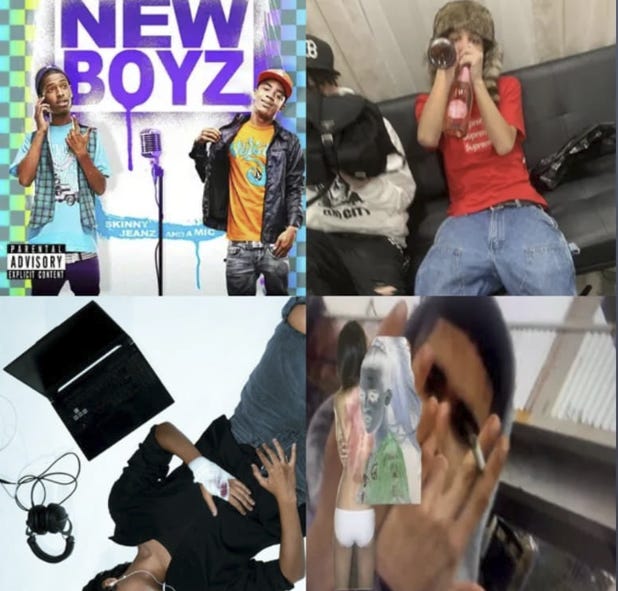
Jerk music arose in the late 2000s in Los Angeles (LA) and derives its name from Jerkin’, a street dance movement that emerged in high schools across the West Coast. The dance-driven movement captured mainstream attention with tracks like “You’re a Jerk” by New Boyz and “Teach me how to Jerk” by Audio Push in 2009. Subsequently, the movement blew up across the United States, and once major labels co-opted the style, quickly faded out of relevance. Jerkin’ was a whole aesthetic and its influence on Western pop culture has resonated across the globe—if you were to check out styles and sounds from the time, you can trace a direct line between your elder cousin’s (the one who watched MTV) Facebook-posts’ wardrobe to the music soundtracking your most recent Instagram doomscroll. And that’s because Jerk made a comeback in the 2020s. It was now the “Nu-Jerk” movement. Original Jerk was characterized by bouncy 808s, suppressed basslines, and Hi-Hats paired with a catchy synth spammed multiple times over until you had the whole classroom dancing. It was optimized to control limb movements. Nu-Jerk takes these same production elements and turns them up a notch. We aren’t dancing as much anymore2, and nu-jerk isn’t concerned with getting us to do so either. Instead, nu-jerk pioneers like xaviersobased, fakemink, and YT build their tracks on electronic and noise music sounds. Traditional Jerk elements are slapped on to ensure that you can still headbang or nonchalantly step to if you unexpectedly encounter this track at a party. Vibes-based writing and the occasional punk guitar round out the update. It is as much electronic music as it is rap. Now, two of the three artists mentioned above are UK-based and that is because the nu-jerk movement has emerged on the back of a Y2K Nostalgia wave3 sweeping the British underground scene. In the 2020s, British rappers have discovered, co-opted, and expanded retro US aesthetics to fit into their culture. You suddenly have music videos that look like they have been shot on flip phones from the 2010s. Jerkin’ and its DIY styling are cool again. Having fun is cool again.
Around 2021, rumours of a potential Seedhe Maut and Ritviz collab album began floating around. The album was ultimately shelved, and only two tracks came of it, “Roshni” and “Chalo Chalein.” But even from these two tracks, you can sort of see the vision that the trio was going for. “Roshni” features a rich piano and guitar-driven melody over which Ritviz stacks vocals to create an airy atmosphere that Seedhe Maut promptly cut through with choppy verses rich in detail. The song sounded fresh because they did not follow conventional EDM rap tropes where the hip-hop verse is neatly isolated from the electronic bits. Similarly, on “Chalo Chalein”, the rap and production are in constant interaction. Further, the soundscapes are unmistakably Indian, leaving no doubt that they spawn from authentic experience. After their split, neither party attempted to continue developing this concept, and it seemed like everyone had moved on. Then, in 2025, Seedhe Maut founded their record label, DL91 ERA. Over the past year, with producers Hurricane and RiJ behind the decks, this Indo-EDM-rap vision has found new direction, and the collective has attempted to push the sound forward by incorporating nu-jerk and trap elements. Their tracks never let up, and the sound is driven by relentless 808s and synth-lines, making it ripe mosh pit fodder. Arguably, it even takes the nu-jerk sound forward by inviting the listener to sing along, something nu-jerk of the West actively avoids. Given this increased focus on melody, “Indo-Jerk” expects the track to centre around the vocals, resulting in increased scrutiny, and subsequently, focus, on lyric-writing—a mostly overlooked expectation for its Western counterpart.
Perhaps the most overt influence of nu-jerk on DL 91 is seen in Hurricane’s album GORE!. First off, shout out to Hurricane’s range and work ethic, man. The album has almost entirely been composed and produced by him, and introduces him as a solo artist on the label. Skitzy guitar riffs and suppressed 808s make up most of the soundscape. Hurricane uses his vocals as an instrument, pitching them up to ride the urgency created by the chipmunk synths he uses throughout the record. GORE! is the soundtrack for all the sped-up emotes and reels you see of people on your feed. “waste” sounds like a remix of “father” by Jim Legxacy, another proponent of the UK nu-jerk wave. It isn’t, but the drum bounce is unmistakable. Hurricane speeds up an already-sped up sample while rapping along like how you would if you were singing along to a track in the shower. It is cheeky, strangely intimate, and also the perfect song for Diya Joukani’s next fit check reel. Hurricane takes the nu-jerk sound to more melancholy territory, injecting uncertainty and noise onto all that he touches. Even the celebratory “dost!” with friends and label-mates OG Lucifer and Encore ABJ is not spared, almost devolving into noise as the track winds down. Distortion complements perfectly the style of Ab 17, another labelmate—on “BAAWE ON GO” off of the project BAAWE Era, his snarling vocals neatly ride the chaotic 808s as the beat disintegrates and resurrects around him. On “CRITICS”, Ab 17 follows his cross-continental counterparts into noise territory, and barring Calm’s verse which doesn’t quite work, the track is menacing and serves as an extension of Hurricane’s vision with GORE!
In contrast, DALLI by Bhaskar features a more light-hearted soundscape. While the connotations of the word “Dalli” in the context of the album are ambiguous at best, the album itself, a love letter to Delhi and Bhaskar’s lover (it gets confusing), oscillates between old-fashioned Boom-Bap, R&B, to Bollywood Party music on a sugar-rush. Bhaskar has been playing around with the jerk sound for a while now—”DAINIK BHASKAR” from his previous project, KHACHRA ULTIMATE, is built off an earworm synth melody and 808s designed to be danced to. Bhaskar delivers a monotone flow high in shock value over a Hurricane beat that never stops pounding your ears. On DALLI, Indo-Jerk’s presence is either direct, as in the title track and “Madhu-Re”, or subtle, as in “Baat Banjayegi” where house-influenced drums lift the mood of the track from yearning to yearning-but-dancing. “Dalli” fully crystalizes what I imagine the Indo-Jerk sound to be—delirious, a clear intention for melody that invites a sing along, and unmistakably Desi. The guitars are turned up to their squeakiest, and the 808s are incessant, squeezing in as much dopamine into you as possible. You can tell that the artists had fun making it. Another highlight is the quirky “Kya Kiya Tune Saath Mere,” where the brashness of an anime intro the track is built on attempts to puncture the tenderness of the vocals, as if trying to incite Bhaskar.
The ethos of Jerk music was to dance with abandon. Dance with those around you, with what you have, and maybe get a burger after. This happiness lasted five years before corporations decided to codify this joy into a reproducible cash cow—and when they failed to do so, the subculture died a lonely death, its proponents having long moved on. A decade later, this movement, this moment of freedom, found common cause 7000 kms away, traversing this distance via the internet. Nu-Jerk celebrated the campiness of American retro aesthetics and found joy in setting it to a gloomy rainy London backdrop. Then, in an ascending Indian hip-hop scene, nu-jerk was reinvented once again to serve as a vehicle to introduce a new sound, and label, to the subcontinent. Each time the sound has re-emerged, it has arrived in an entirely new context without somehow losing its soul. The internet is a divisive, jarring, and an increasingly reclusive space. But sometimes, joy, and the freedom it celebrates, finds its way in this turbulent digital sea. I sure hope this is worth it all.
